The Landfiles DSS calculates, field by field, the yield that is actually achievable, the nitrogen, phosphorus and potassium doses to apply, and the effect of organic amendments over several growing cycles. You compare strategies before you decide.
Most fertilization plans rely on standard doses per crop. They ignore what the soil already supplies, what the previous crop took up, and what the residues will return.
Without a diagnosis, a standard input can be well in excess for one nutrient and insufficient for another. The surplus is costly and produces no additional yield.
Common tools optimize the coming harvest. They don't show the cumulative effect of inputs on organic matter, pH and soil reserves three years down the line.
Yield isn't the sum of favorable factors: it's the weakest one that sets the ceiling. Correcting a factor that's already fine changes nothing while the limiting factor remains in place.
Many tools deliver a figure without explaining where it comes from. An agronomist has no way to discuss it, challenge it, or adapt it to a specific situation.
The Landfiles DSS formalizes the agronomic reasoning you already carry out — but chains it across multiple cycles and makes it reproducible from one field to the next.
You enter the results of your soil analysis: pH, total nitrogen, Olsen phosphorus, available potassium, CEC, organic matter, texture (sand, silt, clay), bulk density and reference horizon. The system immediately classifies each parameter — critical, low, medium, good — and displays help panels explaining what each value measures and how to estimate it in the field when it's missing.
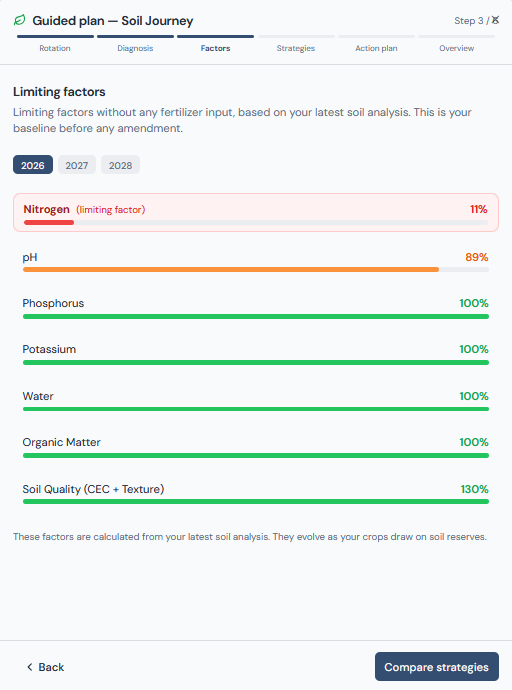
The engine scores six factors — nitrogen, phosphorus, potassium, water, pH and organic matter — then takes the lowest one to set the yield ceiling, following the law of the minimum. A soil quality index calculated from CEC and texture then adjusts this result. You don't just get a number: you see which of the six factors is constraining the field, and by how much.
Starting from your target yield, the system calculates what the crop will remove, subtracts what the soil mineralizes and what the previous crop's residues return, then derives the dose to apply. Target thresholds for phosphorus and potassium are not constants: they depend on the field's clay content, pH and CEC. Every soil therefore sets its own target.
The simulation is chained. What the harvest removes, what the inputs return, the acidification caused by nitrogen fertilizers, the decline or rebuilding of organic matter, the change in CEC: all of it carries forward into the starting state of the next cycle. Every decision made today changes tomorrow's soil.
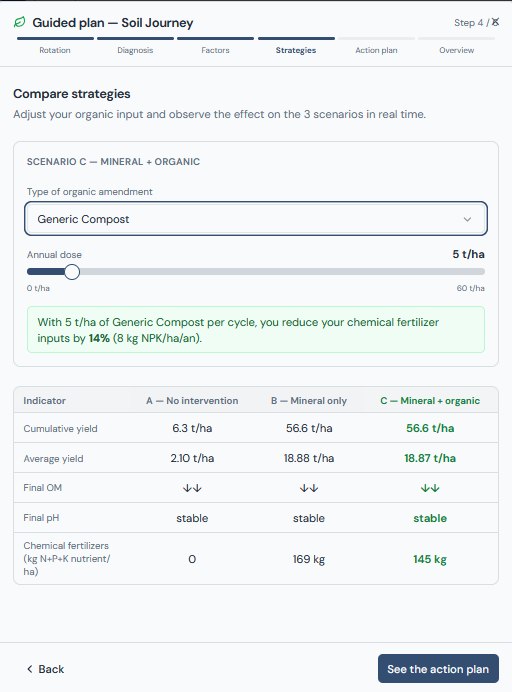
The guided workflow compares three trajectories over the length of your rotation: no input at all, mineral only, and organic supplemented with residual mineral. You adjust the organic amendment dose and watch, in real time, the effect on yield, final organic matter, pH and the amount of chemical fertilizer used.
The guided workflow takes the user through six steps, from defining the rotation to the long-term summary. Here are four key moments, based on a three-cycle rotation combining tomato and potato.
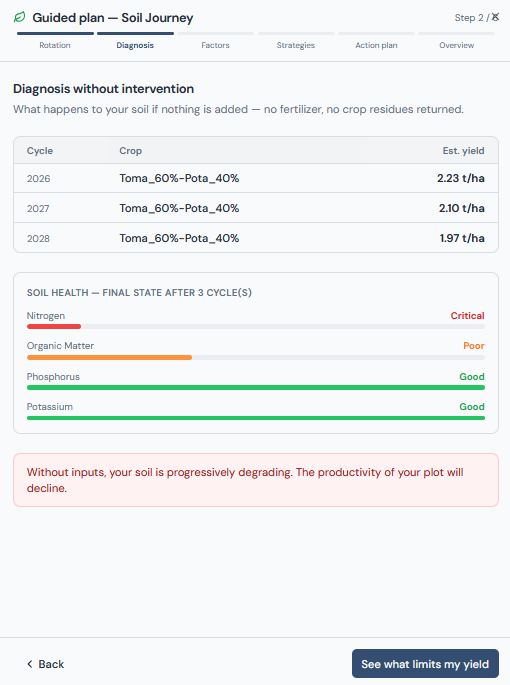
Screenshots of the application, currently in development.
Everything starts from the field and its analysis. Each module draws a different decision from it, using the same data and the same rules.
Every parameter is classified and shown visually, with the limiting factor highlighted. Help panels explain what each value measures, why it matters, and how to estimate it in the field without equipment when it's missing.
The engine applies the law of the minimum to six factors and returns not just an estimated yield, but the score for each factor, the name of the one that's limiting, a confidence level, and any alerts on the data entered.
N, P and K doses are calculated from what the crop removes, what the soil supplies, and what the residues return. You then convert the requirement into actual products from your catalogue, with the coverage rate achieved for each nutrient.
Blend two or more varieties by adjusting their proportions: the system computes a synthetic variety — yield, water requirement, removal rates, sensitivities — which is then handled like any other crop. The blend becomes a first-class object, not a workaround.
Build a sequence of cycles and enter, for each one, the crop, the target yield, the organic and mineral inputs, the share of residues returned, and the irrigation. The simulation recalculates with every change and carries the effect forward from one cycle to the next.
Based on the crop's water requirement, effective rainfall, soil texture and your level of access to water, the system calculates the net and gross requirement, the recommended irrigation frequency, the volume per application, and the rainfall threshold above which an application becomes unnecessary.
Every recommendation traces back to a soil value and a named agronomic rule. An agronomist can check it, discuss it and correct it.
The soil isn't reset to zero every year. Every decision changes the starting state of the next cycle, and the simulation shows it.
Composts, manures, crop residues, organic matter and rotations are modelled at the same level as mineral fertilizers.
The system proposes, the user adjusts. Every parameter stays editable — the goal isn't to replace the decision, but to inform it.
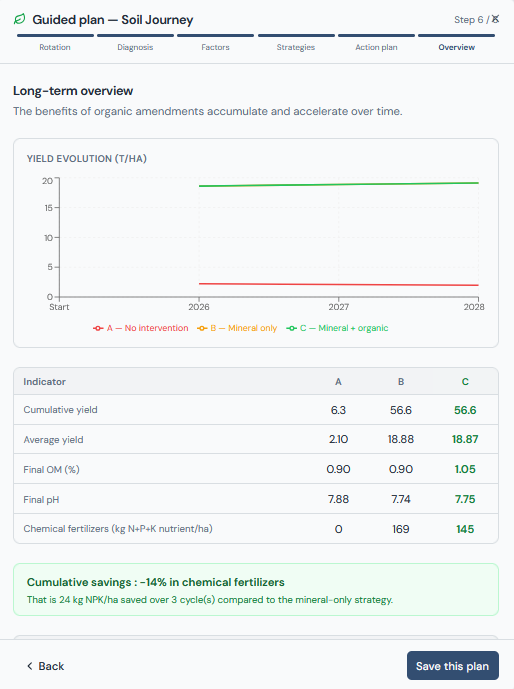
In the simulation shown above — three cycles of a tomato–potato rotation — the DSS compares three strategies. Scenarios B and C reach the same cumulative yield, but not at the same cost, and not with the same soil at the end.
| Indicator over 3 cycles | A — No input | B — Mineral only | C — Mineral + organic |
|---|---|---|---|
| Cumulative yield (t/ha) | 6.3 | 56.6 | 56.6 |
| Average yield (t/ha) | 2.10 | 18.88 | 18.87 |
| Final organic matter (%) | 0.90 | 0.90 | 1.05 |
| Final pH | 7.88 | 7.74 | 7.75 |
| Chemical fertilizer (kg N+P+K/ha) | 0 | 169 | 145 |
Between the mineral-only scenario and the scenario combining compost with a mineral top-up, the cumulative yield is identical — but 24 kg of N+P+K per hectare were saved over three cycles, 14% less chemical fertilizer, and organic matter rose instead of stagnating. The benefits of organic amendments accumulate and accelerate over time: the more organic matter builds up, the more nitrogen the soil mineralizes, the more water it retains, and the better it buffers acidification.
The Landfiles DSS doesn't learn from historical data: it applies written, documented and verifiable agronomic rules. That's what makes it possible to justify every dose to a farmer, an agronomist or a certification body.
Web application, with the simulation recalculated in real time at every parameter change.
No learned statistical model is involved in computing the recommendations.
The DSS is built first for those who advise — because the value of a recommendation lies as much in its accuracy as in the ability to explain it.
Produce a well-argued fertilization plan per field in a few minutes, and show the farmer exactly where each figure comes from. The reasoning stays the same from one file to the next.
Standardize the advisory method across an entire network. Calculation rules are shared, and crop and input catalogues are configurable at the organization level.
Test a rotation, a compost dose or a residue return rate, and see the effect on yield and soil before committing to the season. The guided workflow requires no prior expertise.
Yes, the soil analysis is the entry point for the whole system: pH, total nitrogen, Olsen phosphorus, available potassium, CEC, organic matter, texture and bulk density.
When a value is missing, the application offers field-estimation methods — a hand-texturing test for texture, test strips for pH, visual indicators — together with an interpretation range. The confidence level of the yield estimate is adjusted accordingly.
The system relies on a catalogue of crops and varieties, each carrying its reference yield, water requirement, nitrogen, phosphorus and potassium removal rates, the share returned by residues, and its sensitivities.
This catalogue is extensible: you can add your own varieties, adjust their parameters, and create mixes from several parent varieties.
By mass balance. The system starts from what the crop will remove for the target yield, subtracts what the soil mineralizes and what the previous crop's residues return, then applies only the remaining deficit.
For phosphorus and potassium, the target threshold isn't a constant: it's recalculated from the field's clay content, pH and CEC. Two different soils therefore don't share the same target.
No, and that's a deliberate choice. The engine is entirely deterministic: it applies written agronomic rules — the law of the minimum, mass balance, a soil-evolution model — with every step documented.
Two identical calculations always give the same result, and any recommendation can be traced back to the soil value and the rule that produced it. It's this traceability that makes the advice open to discussion, and therefore defensible.
No. The goal isn't to replace the decision, but to base it on transparent calculations. The system proposes; the user adjusts every parameter — target yield, products, doses, share of residues returned, irrigation.
Above all, it makes the reasoning readable for someone who isn't an agronomist, which makes it as much an advisory tool as a basis for dialogue.
The application is in its agronomic validation phase. The access button on this page will be activated as soon as it opens.
In the meantime, you can request a demo: we'll run it on your own soil analyses and rotations.
We run the Landfiles DSS on your own analyses and rotations, and show you what the simulation changes in your fertilization plan.
Page last updated in August 2026.